
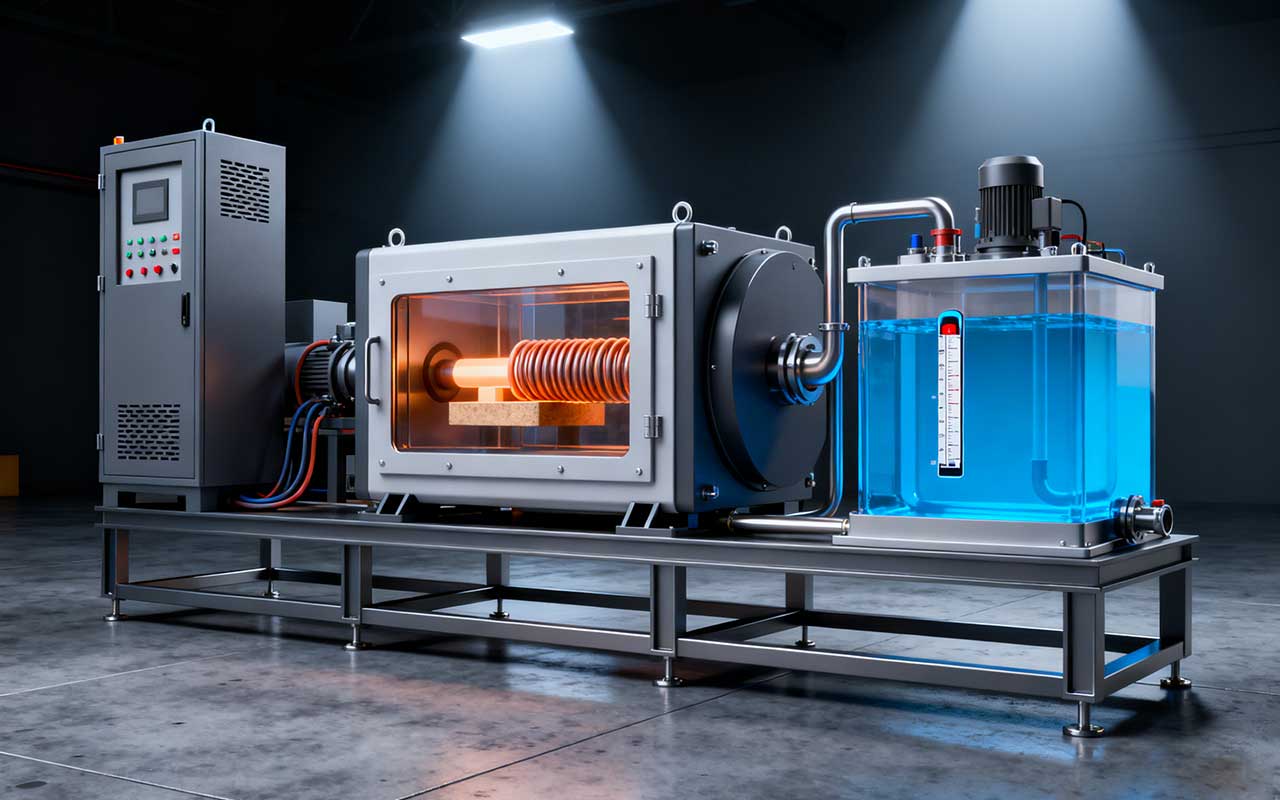
In industrial heating processes—from automotive part hardening to aerospace component brazing—induction heating systems stand out for their precision, efficiency, and sustainability. But what makes these systems deliver consistent, high-performance results? The answer lies in their carefully engineered components, each playing a non-negotiable role in converting electrical energy into targeted heat. Whether you’re an engineer specifying equipment, a plant manager optimizing operations, or a buyer evaluating options, understanding the composition of an induction heating system is critical to maximizing ROI and avoiding costly downtime.
This guide breaks down the core components of induction heating systems, their functions, and how they work in harmony. We’ll also share insights into selecting components tailored to your application—so you can build or choose a system that meets your exact needs.
The Core Principle: How Induction Heating Systems Work
Before diving into components, it’s essential to grasp the foundational physics that powers induction heating. Unlike traditional methods (flame, resistance) that transfer heat externally, induction heating generates heat inside the workpiece itself via electromagnetic induction . Here’s the simplified process:
-
A high-frequency alternating current (AC) flows through an induction coil, creating a rapidly changing magnetic field around it.
-
When a conductive workpiece (e.g., steel, aluminum) is placed in this magnetic field, eddy currents are induced within the material.
-
The workpiece’s inherent electrical resistance opposes these eddy currents, generating friction at the molecular level—that friction becomes heat.
This internal heating is what makes induction systems fast, energy-efficient (60-90% energy conversion rates ), and precise. Now, let’s explore the components that make this process possible.
Primary Components of an Induction Heating System
Every induction heating system—whether for small-batch lab work or high-volume industrial production—relies on four core components, plus critical support systems. Each part is interdependent: the system’s performance is only as strong as its weakest link.
1. Induction Heating Power Supply: The “Brain” of the System
The power supply is the heart and brain of the induction heating system. Its primary job is to convert standard grid AC power (e.g., 220V/380V, 50/60Hz) into high-frequency AC power (typically 1kHz to 400kHz) suitable for induction heating . Modern systems use solid-state radio frequency (RF) power supplies, which offer far greater control and reliability than older vacuum-tube designs.
Key Functions & Attributes:
-
Frequency & Power Control: Adjusts output frequency and power to match the workpiece’s material, size, and heating requirements. For example, small, thin parts need higher frequencies, while large, thick components require lower frequencies.
-
Resonance Tracking: Advanced power supplies automatically track the load’s (coil + workpiece) resonant frequency. This is critical because a workpiece’s electrical properties (resistivity, permeability) change with temperature—especially near its Curie point . Without resonance tracking, efficiency drops sharply.
-
Integration Capabilities: Interfaces with PLCs and automated production lines (Industrial 4.0) for seamless operation, remote monitoring, and consistent quality control.
Look for power supplies with digital controls, real-time temperature feedback, and overload protection to ensure durability and ease of use.
2. Induction Coil (Inductor): The “Energy Transmitter”
The induction coil—often called the inductor—is where electrical energy becomes a magnetic field. Typically made from hollow, water-cooled copper tube (to handle high currents without overheating), the coil’s design directly dictates how heat is distributed in the workpiece . It’s the most application-specific component: a coil tailored to your part will deliver optimal efficiency and precision.
Common Coil Designs & Their Uses:
-
Helical (Solenoid) Coil: The most widely used design—multiple turns of copper tube wound in a spiral. Ideal for heating cylindrical parts (e.g., shafts, gears) or long components via “scan heating” (moving the part through the coil).
-
Pancake Coil: A flat, disk-shaped coil used for heating flat surfaces, small target areas, or parts that can’t be surrounded by a helical coil (e.g., large plates, localized brazing).
-
Split Helical Coil: A hinged design that opens to accommodate parts with complex geometries (e.g., bulky assemblies, parts with protruding features) that can’t fit into a solid coil. Silver-plated contacts ensure good electrical conductivity between the split halves.
-
Multi-Position Coil: Features 2-8 separate heating zones to process multiple parts simultaneously, boosting throughput for high-volume production.
The coil’s proximity to the workpiece (called “coupling”) is also critical—closer, more precise fitting coils transfer energy faster and reduce waste heat .
3. Workpiece: The “Active Component”
Unlike passive materials in traditional heating systems, the workpiece is an active part of the induction heating circuit. For induction to work, the material must be electrically conductive—ferrous metals (steel, iron) are most efficient due to their high magnetic permeability, but non-ferrous metals (aluminum, copper) and even some alloys work too.
Workpiece Properties That Impact Performance:
-
Conductivity: Materials with higher conductivity (e.g., copper) require higher frequencies to induce sufficient eddy currents.
-
Permeability: Ferromagnetic materials amplify the magnetic field, making them heat faster—this effect drops off above the Curie point (the temperature where magnetism is lost).
-
Geometry: Thin-walled parts or small components heat more uniformly than thick, irregularly shaped pieces (which may need custom coils for even heating).
4. Cooling System: The “Protector” of Longevity
The high currents flowing through the power supply and coil generate significant waste heat—even with efficient energy conversion. Without proper cooling, components would overheat, melt, or fail prematurely . A cooling system is therefore not an optional accessory—it’s a mandatory part of any industrial induction heating setup.
How Cooling Systems Work:
-
Water Cooling (Most Common): Deionized or filtered water circulates through the hollow copper coil, power supply, and work head (if equipped) via a closed-loop system. The water absorbs heat and transfers it to a heat exchanger or chiller.
-
Air Cooling: Only suitable for small, low-power systems (e.g., lab-scale units) where heat generation is minimal.
For reliability, choose a cooling system with flow sensors and temperature alarms—these prevent damage if water flow is interrupted or temperatures rise too high.
Secondary Support Components
While not core to the induction process, these components ensure safety, efficiency, and usability:
-
RF Power Cables: Specially designed cables that transmit high-frequency power from the supply to the coil without signal loss.
-
Work Head: Houses capacitors and additional circuitry to optimize the magnetic field, often used in larger systems.
-
Quenching System: For heat treatment processes (e.g., hardening), a quenching unit (water, oil, or gas) rapidly cools the workpiece after heating to achieve desired material properties.
-
Control Panel: Provides operators with intuitive access to power, frequency, heating time, and safety controls—critical for repeatable results.
How to Choose the Right Components for Your Application
Not all induction heating components are interchangeable. To build a system that delivers maximum efficiency and ROI, focus on these application-specific factors:
-
Match Power Supply to Workload: Calculate required power (kW) based on workpiece weight, material, and heating cycle time. A 5kW supply may suffice for small parts (e.g., surgical tools), while automotive gear hardening needs 50kW+.
-
Customize the Coil: Never settle for a “one-size-fits-all” coil. A custom-designed coil (matching your part’s geometry) can reduce heating time by 30% and improve energy efficiency.
-
Prioritize Cooling for 24/7 Operations: For continuous production lines, invest in a high-capacity chiller with redundant pumps to avoid unplanned downtime.
-
Ensure Compliance: Choose components that meet industry standards (ISO, CE, IATF 16949 for automotive) to avoid safety risks and regulatory issues.
Final Thoughts: Components = System Performance
An induction heating system’s success hinges on the quality and compatibility of its components. The power supply’s precision, the coil’s design, the workpiece’s properties, and the cooling system’s reliability—all work together to deliver fast, efficient, and consistent heating. By understanding each part’s role, you can make informed decisions when designing, upgrading, or purchasing an induction heating system.
Whether you’re in automotive, aerospace, medical devices, or manufacturing, we specialize in custom induction heating systems—from component selection to full turnkey solutions. Contact our experts today to discuss your workpiece specifications, and let’s design a system that fits your exact needs.
Ready to optimize your induction heating process? Reach out now for a free component consultation and quote.
Component Quick-Reference Table
|
Component
|
Core Function
|
Key Selection Factor
|
|---|---|---|
|
Power Supply
|
Converts grid power to high-frequency AC
|
Frequency range, power output, resonance tracking
|
|
Induction Coil
|
Generates targeted magnetic field
|
Workpiece geometry, heating pattern
|
|
Workpiece
|
Conducts eddy currents to generate heat
|
Conductivity, permeability, size
|
|
Cooling System
|
Dissipates waste heat from components
|
System power, duty cycle, space constraints
|
