
4-Axis Induction Hardening Machine for Complex 3D Geometries
Unlike single-axis or fixed-position hardening systems that struggle to access hard-to-reach areas (e.g., curved surfaces, recessed features, or asymmetric profiles), the multi-axis design (typically 3 to 6 axes linkage,or more for specialized applications) enables the induction coil to move in precise, programmable paths around the workpiece. This means the machine can adapt to every contour of the part — whether it’s a camshaft’s lobes, a crankshaft’s journals, or a turbine blade’s airfoils — ensuring uniform heat distribution and consistent hardening depth across even the most complex surfaces. The multi-axis linkage eliminates the need for multiple setups or manual adjustments, drastically reducing processing time and minimizing the risk of human error.
Its intuitive HMI (Human-Machine Interface) allows operators to program, store, and recall custom motion paths and process parameters (e.g., heating intensity, dwell time, cooling rate) for different part models, enabling seamless changeovers between complex components. Whether you’re hardening a single high-precision aerospace component or scaling production of complex automotive parts, the Multi-Axis Induction Hardening Machine is a future-ready investment that turns the challenges of complex workpiece heat treatment into competitive advantages.
- ZM 3000
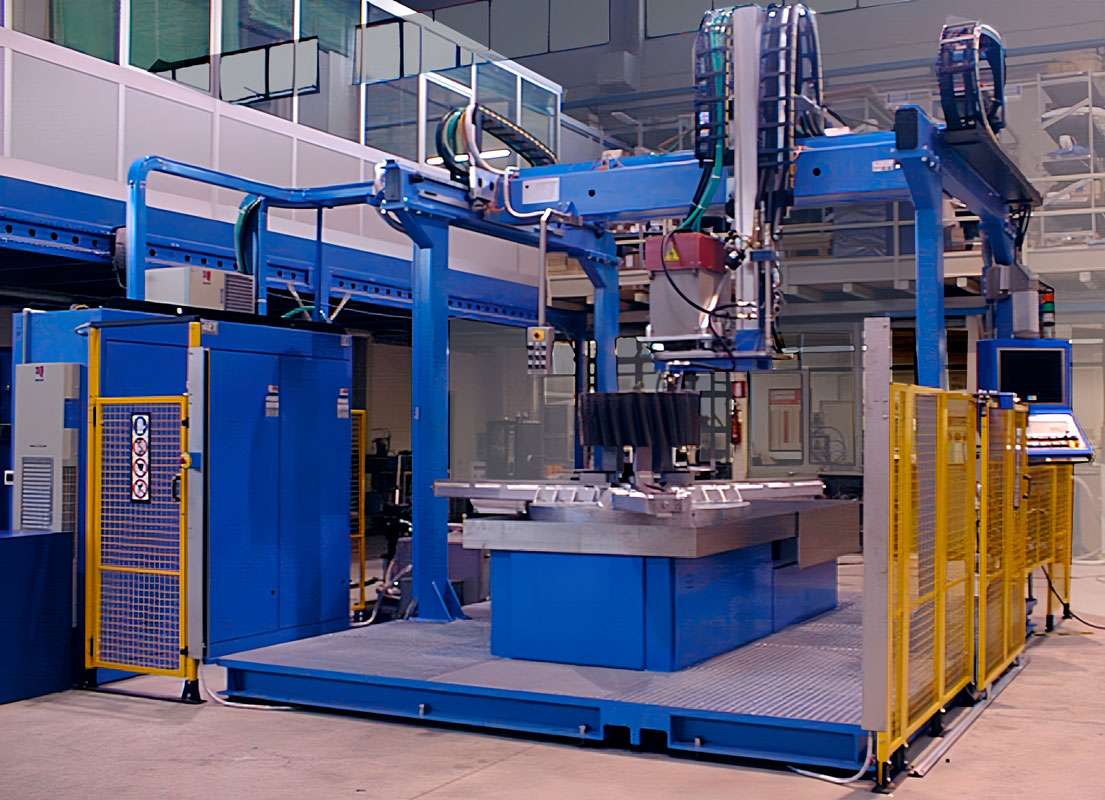
- 4-axis control: rotary + vertical + horizontal + transversal
- Chuck in fix position and full 3-axis heating station movement
- Workpiece diameter up to 3000 mm
- Workpiece height up to 900 mm
- Horizontal travel up to 2500 mm
- Vertical travel up to 1100 mm
- Transversal travel up to 1000 mm
- Automatic self-centring chuck
- Automatic constant gap tuning between inductor and workpiece
- Horizontal guided scanner and conversion of chuck into 3-position index table
- Automatic repeated cycle for tooth by tooth hardening
- Power supply: 150 – 250 kW
- PLC + Industrial computer control system
- User-friendly HMI (Human-Machine Interface)
Optional to integrate a standard vertical scanner webcam, for easy monitoring of hardening zone.
Power Supply for Induction Heating
- High Digital Advantages:Digital control replaces over 70% of traditional electronic hardware. The software enabling command transmission, parameter regulation, operational control, and system protection delivers higher precision and more sophisticated functions.
- User-Friendly O&M Design:The integrated keyboard supports rapid and accurate diagnostics, covering the operating status of all electronic components and cooling systems. A series resonant circuits enable automatic tuning and eliminating the need for manual adjustment when replacing inductors.
- High Adaptability & High Power:With a quality factor (Q-Factor) exceeding 2, it offers strong flexibility, supporting various inductors (both single-coil and multi-coil configurations) while delivering maximum output power.
Core Specifications:
- Output power ranging from 10 kW to 500 kW
- Operating frequency spanning from 100 Hz to 100 kHz
Optional Configurations:
- Dual-output design, supporting manual or automatic switching functionality
- Frequency switching module (high/medium/low), enabling a standard operating frequency reduction of up to 50%
Standard Equipment for All Models:
- Supply transformer
- Chopper voltage regulator integrated with IGBT transistors
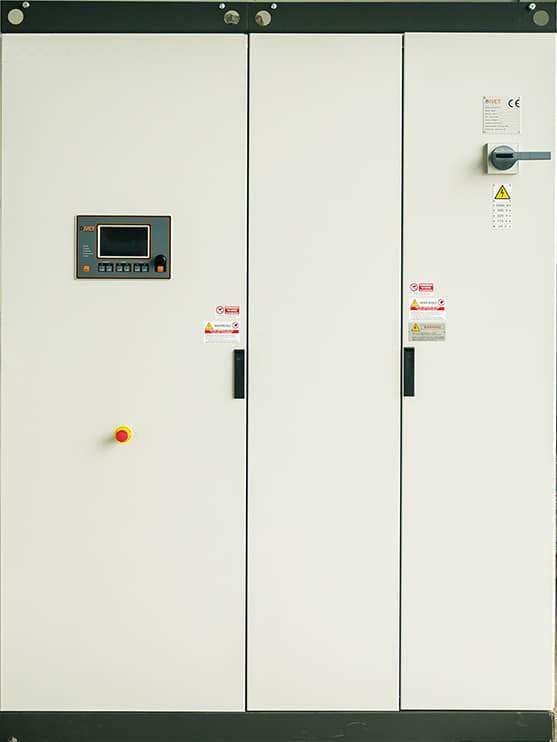
Control Systems
- User-Friendly HMI:The SD focuses on creating intuitive human-machine interface (HMI) software, tailored for unskilled operators to ensure easy operation.
- Safe Operation:Throughout the design process, the SD prioritizes and guarantees safe operating conditions at all times.
Hardware Options
- PLC + Operator Panel, suitable for simple applications
- PLC + Axes Control Unit + Industrial PC, suitable for more complex and advanced machines
- PLC + CNC, suitable for machines with specific functions or multi-axis interpolation capabilities
Software Options:
- Programmable logic (PLC) software, always accompanied by comments
- Human-machine interface (HMI) softwares running on the Windows OS for industrial computers are designed according to machine types with dedicated softwares
- CNC-based applications utilize the ISO language
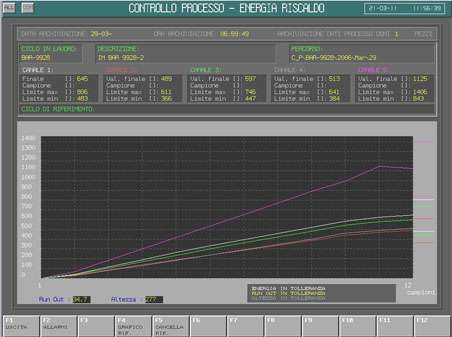
Control Levels
| Basic | Heating energy control and quenching shower flow control |
| Middle | Heating energy control, oscillation frequency, quenching shower flow, and quenchant temperature control |
| Advanced | Heating energy control, voltage control, current control, frequency control, quenching shower flow control, quenchant temperature control, and inductor collision detection |
| Custom | The number of control channels is selected based on the safety level requirements of the process and product. |
Cooling Systems
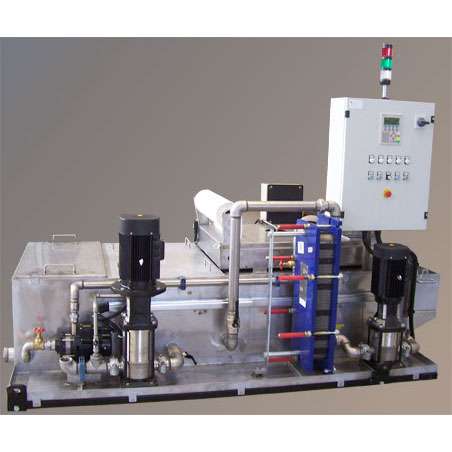
GSC Cooling System
A typical GSC system consists of the following components:
- Stainless steel tank equipped with a minimum level sensor
- Water-to-water heat exchanger in stainless steel
- Main cooling pump made of stainless steel
- Magnetic flow sensors with on-board adjustable alarm set points
Optional Components
- Automatic shutdown function to reduce industrial water consumption
- Automatic antifreeze system and automatic anti-condensation system
- Automatic water conductivity detection system
- Additional pump for high-pressure inductor feeding
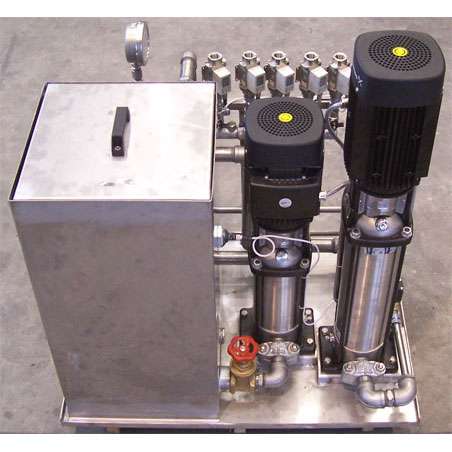
GLT Cooling System
The CLT systems, designed based on power supply specifications and process type, serve as the optimal solution for achieving proper workpiece quenching.
A typical CLT system comprises the following components:
- Stainless steel tank equipped with a level sensor
- Stainless steel cooling pump
- Water-to-water heat exchanger in stainless steel
- Stainless steel shower pump
- Automatic workpiece temperature stabilization system
- Automatic filtration system
Optional Components
- Additional magnetic filtration section
- Automatic pre-heating system based on a weekly schedule
- Automatic system for removing suspended oil
- Automatic quenchant mixture type selection system (applicable when two or more CLT systems are in use)
- Automatic shutdown function to reduce industrial water consumption
Get in touch right now for solutions meeting your specific needs!
